
Why branding and performance are converging again in 2026—and how brands can remain measurable in the process
One campaign for brand image, another for sales – two budgets, two logics, two ways of measuring success. In 2026, this picture is shifting, and a look at the latest figures suggests where things are headed. According to the dentsu Global Ad Spend Forecasts (May 2026 issue), the global advertising market is growing by 5.0 percent, with Retail Media seeing above-average growth of 12.3 percent and Connected TV rising by 11.5 percent. The trend is also evident in Digital Out of Home: according to PQ Media ("Global Digital Out-of-Home Media Forecast 2026-2030"), global DOOH ad spend grew by 12 percent in 2025. Figures like these reveal where budgets are flowing, but they don't yet explain why these specific channels are gaining momentum while, for instance, linear TV remains stagnant at 0.0 percent.
To explain this, we need to look at the mechanics behind the numbers: we are increasingly seeing channels that can do both simultaneously—build reach and prove impact. For Retail Media, the US marketing platform Skai forecasts a 2026 shift in budgets away from traditional, static outdoor advertising and print inserts toward geofence-based retail media in the US market, because target audiences can be addressed more precisely and sales can be attributed more directly than via a static billboard. In Digital Out of Home—which must be clearly distinguished from traditional, non-digital outdoor advertising—a similar pattern is emerging: according to WallDecaux (December 2025), DOOH now accounts for around 44 percent of the total out-of-home market, with a forecast to reach about half of all OOH spending in 2026. At the same time, a growing portion of inventory is being booked programmatically, meaning it can be managed in real-time and data-driven, just like an online campaign. Whether this automatically translates to better brand impact is not yet proven—but it does explain why budgets are moving toward more measurable formats.
This presents marketing decision-makers with a new challenge: How can brand building be structured so that it delivers not only reach but also reliable performance metrics—and where are these two disciplines truly converging?
The separation of brand and sales is rarely as neat as it is in an organizational chart
For many companies, the division into "brand" and "performance" is primarily an organizational convenience: clear responsibilities, clear KPIs, clear budgets. However, purchasing decisions rarely follow this logic: trust in a brand is not built in the final click before a purchase, but in the weeks and months leading up to it. Many performance dashboards ignore this lead-up because they typically only show what happened immediately before the purchase—not what prepared the way for it.
As Emma Huson, Senior Campaign Manager at adlicious, aptly puts it:
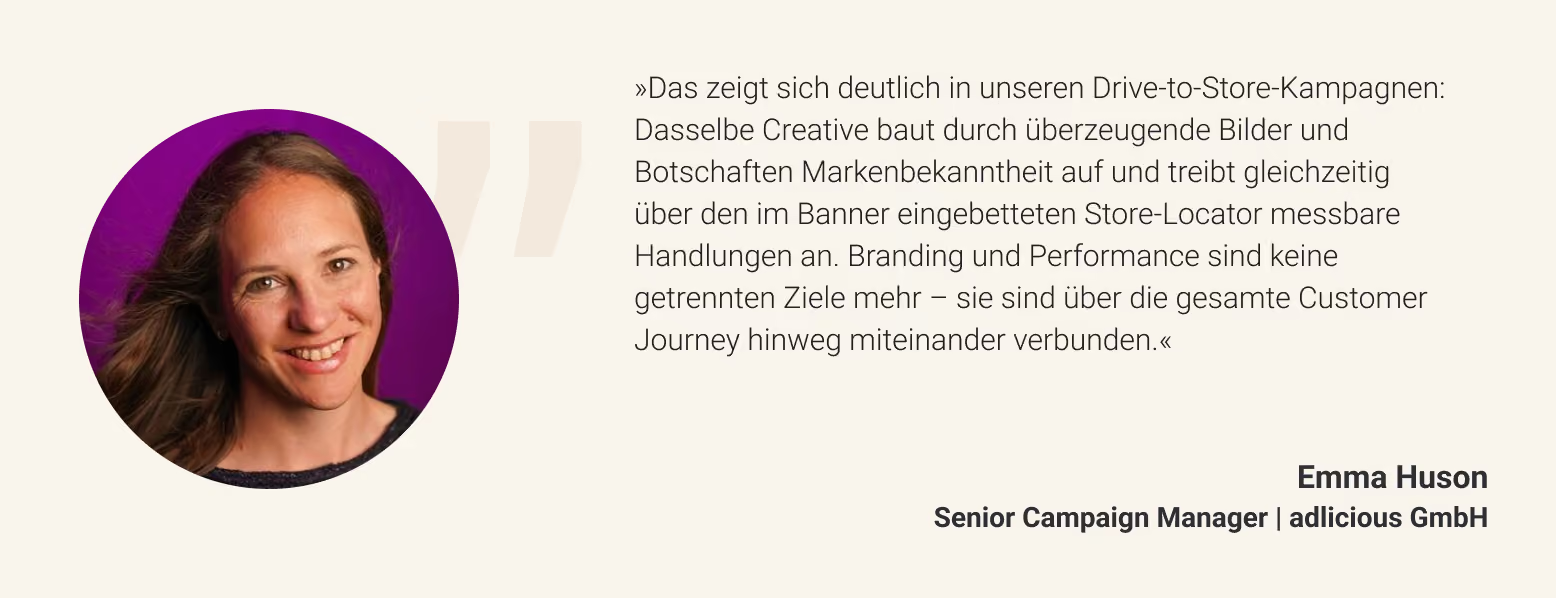
An example from our own campaign practice that shows how closely these two effects can now intertwine.
What the research says
The growth figures from the introduction explain why individual channels are becoming more attractive—but the question of whether integrating brand and performance also pays off strategically can only be answered by marketing effectiveness research. Perhaps the most influential answer to the brand-performance debate comes from Les Binet and Peter Field, who, in their analysis of 996 effectiveness case studies for the UK's IPA, found that a budget split of approximately 60 percent brand building to 40 percent sales activation yields the highest combined profit on average. The analysis by Analytic Partners published in 2025 as part of the WARC report "The Multiplier Effect"—which WARC produced in collaboration with Analytic Partners, BERA.ai, Prophet, and System1—supports this with more recent data: shifting from a pure performance approach to a mixed brand and performance strategy improves total sales ROI by 25 to 100 percent, with an average of 90 percent; the reverse—moving from a mixed approach back to pure performance—costs an average of 40 percent in ROI.
Growth channels that can deliver brand impact and performance simultaneously
When applied to the growth channels mentioned earlier, the mechanism becomes more concrete: Retail Media combines brand presence near the shelf with the retailer's sales data. Connected TV provides the reach of traditional TV advertising with addressable targeting. Digital Out of Home is increasingly being booked locally and store-specifically—as a drive-to-store format that can turn a visual impression into a traceable journey to the store door. In this context, it is worth looking at the "The State of Shopping 2025" study by Shopfully (March 2025, n = 9,482 respondents in nine European countries, including 1,110 in Germany): 80 percent of Germans research online before visiting a store—a behavior Shopfully calls ROPO ("Research Online, Purchase Offline").
In practice, this could look like this: A retail brand launches a CTV campaign for nationwide brand awareness while simultaneously running geofenced DOOH screens and retail media placements around its own stores in a subset of regions. In a comparable control region, only the CTV campaign runs, without local activation. A brand lift survey measures the impact of the CTV campaign on brand awareness and purchase intent nationwide; at the same time, a geo-incrementality test compares visitor numbers and sales in the DOOH/retail media regions against the control region. In this way, a single campaign setup can at least approximately separate and jointly evaluate both the contribution to brand impact (CTV, brand lift) and the additional sales uplift from local activation (DOOH/retail media, geo-test).
Where measurability reaches its limits
Not every brand impulse can be neatly isolated. Last-click attribution rarely reflects reality when a CTV spot or a DOOH screen influenced a purchase decision days earlier—yet conversely, pouring too much budget into elaborate test designs instead of reach risks losing sight of the actual driver. The 60/40 rule is also not a law of nature that can be applied unthinkingly to every campaign: it varies depending on brand size, category, and competitive landscape. What matters is not the exact ratio, but the willingness to consider brand and impact within the same campaign and measurement model rather than in separate reports.
Conclusion: Convergence does not mean treating everything the same
We are convinced that the separation of branding and performance in most organizations is a result of history rather than strategy—two budget pots, two teams, two success metrics. The fact that Retail Media, CTV, and DOOH are growing at an above-average rate in 2026 does not automatically prove this. Nevertheless, it fits a pattern that effectiveness research has shown for years and that is confirmed in adlicious' own campaign practice: those who think of brand building and performance in the same campaign setup do not sacrifice reach on one side and relevance on the other, but gain both—from the first visual contact on the big screen to the store visit, which we make trackable across multiple channels in our drive-to-store campaigns.
Have questions? The adlicious team looks forward to connecting— get in touch now.