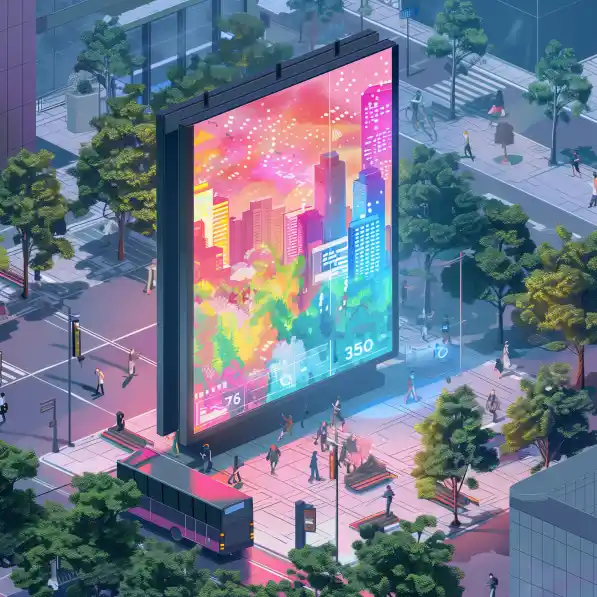

What targeting in Dynamic DOOH can and cannot do
The fields of application of DOOH advertising are diverse today. From medical practices to supermarkets, airports to subway stations — there are many touchpoints where you can advertise your own product or service. Where everyone agrees: Thanks to one-to-many communication, very high reach can be achieved in the target group — but that “in the target group” should be examined in more detail, as this is definitely a controversial issue.
What targeting can be done in DOOH — and what cannot? That is what today should be about.
It was recently said that a marketing approach could be used with a technological solution to programmatically play on certain DOOH steles exactly when the relevant target group is there at that very moment.
The claim is therefore: Thanks to the technology and programmatic login, a user who shows a high level of interest in buying a car due to his online behavior can be addressed via DOOH with the corresponding advertising message at exactly the time he is in front of the corresponding screen.
Why the marketing approach cannot be implemented in this form
In order for the specified target group to actually see the advertising material, the programmatic booking would have to be played out in real time — and this is exactly where the problem lies.
Although real-time bidding makes payment for advertising space in real time, real-time playback remains unaffected. In contrast to the display environment, the booked advertising space is not displayed within seconds, but within minutes or even hours. The actual latency between booking and playback varies depending on marketer and demand.
Conversely, this means that the disguised user has long since boarded the train or walked past the stele in the pedestrian zone when the advertising material is actually being played out.
How can relevant and data-driven advertising be placed in DOOH despite the longer latency period?
By promoting advertising messages that depend on the location but allow a certain amount of time. At adlicious, for example, we ran Dynamic DOOH campaigns with a consumer electronics retailer whose locations are represented throughout Germany.
Thanks to our technology, we were able to market each branch location individually. For this purpose, a radius around the corresponding branches was first determined in order to identify relevant DOOH steles. The advertising material was structured in such a way that, in addition to the products to be advertised, an address variable was always visible.
Depending on the branch location, the corresponding street, zip code and city as well as other information such as the place of interest or the nearest bus stop were automatically transferred in this address variable. In addition to product placement, the corresponding location was therefore always advertised in order to provide the user with the best possible information about possible travel routes.
As a result, we have created a marketing approach that educates the user about the nearest POS and at the same time strengthens the local branch.
In addition to location-based data, a variety of API data (interfaces to secondary data such as from weather platforms) can also be used for product advertising. We have listed possible use cases that we can implement here:
Weather data using Consumer Care & Fashion as an example:
Advertising of an antiallergic agent to prevent hay fever with reference to the current pollen load in zip code 20255 (Hamburg)
Advertising sun protection with reference to the current high UV radiation in zip code 50823 (Cologne)
Promoting different clothing styles, depending on Weather and temperature during a specific season:
Rain, 17°C — 22°C:
Advertising long pants and rain jackets
Higher temperatures, > 20°C:
Promoting sunglasses, shorts and T-shirts
Cooler temperatures, < 20°C:
Advertising long pants, sweaters and between-seasons jackets
Traffic data using public transport as an example
Advertising the available flight or train tickets for a specific route with a reference to a multi-day route Partial lock The A1 between Hamburg and Cologne.
Offers that change every week
Particularly interesting for retailers: Here, steles are booked near supermarkets, for example, where the weekly changing offers rotate. The layout of the advertising material always remains the same — only the product name, product image and price are automatically updated weekly.
Summarizing
Of course, DOOH will never be able to offer the granular targeting options that are the case with Display, YouTube or Social. The channel is and remains a channel of one-to-many communication. However, this can address specific target groups with high reach through smart setups and strong marketing concepts. All that is needed is to identify each case individually and with great care for the desired advertising goals in order to achieve the desired results.
Are you now interested in which set-up can be used to transfer Dynamic DOOH to your product or service? We would be happy to advise you on this without obligation and look forward to hearing from you!